
Wasps, hornets and yellow jackets are part of outdoor life around Cincinnati. You will see them near flowers, trash cans, decks, sheds and picnic areas, and most of the time they are passing through.
An active nest near the house is different. A nest by a doorway, patio, deck, garage, shed, play area or walkway puts your family, your pets and your guests within range of insects that defend their home when they feel threatened. That is the point where a pest problem becomes a safety problem.
So the useful question is not “can I spray this myself?” It is “is this nest close enough to people that it should be handled properly?”
Why stinging insects are a different kind of problem
Ants in the kitchen are annoying. Roaches are unsettling. Rodents are stressful. Stinging insects are the one category where the risk is immediate.
Some nests are easy to see. Others are hidden in the ground, inside wall gaps, under rooflines, in shrubs or behind outdoor structures, which makes them hard to judge from a distance. The closer the nest is to daily activity, the more careful you need to be.
Why August is the worst month for this
If it feels like wasps get angrier as summer goes on, you are not imagining it.
By late summer the colony is fully grown, so there are simply far more insects than there were in June. At the same time the natural food supply starts running short. Workers are out in force looking for food to sustain the nest, and they are more defensive about protecting it. That combination — peak numbers, scarce food — is why the nest nobody minded in June becomes the reason nobody uses the deck over Labor Day.
Colonies do not shrink on their own. They keep growing until cold weather ends them. The longer a nest is left, the larger and more defensive it gets, which is the whole argument for dealing with one in spring when it is a single queen and a structure the size of a golf ball.
Signs it is time to call
You do not need to call about every wasp you see. These are the situations that warrant it.
The nest is near a door, deck, patio or walkway
Front and back doors, garage entries, decks, patios, porches, walkways, outdoor seating, playsets, pool areas, mailboxes and trash bins all create repeat contact. Every time someone walks past, the insects may read the movement as a threat.
A nest near a high-traffic area is worth assessing, particularly if children, pets or older adults use the space.
Insects are going in and out of a hole in the ground
Ground nests are the single biggest reason to avoid DIY. Yellow jackets often nest underground — there is no paper nest hanging in a tree, just steady traffic in and out of a small hole in the soil, near mulch, under a shrub or along a lawn edge.
That becomes dangerous during ordinary yard work. Mowing, trimming, gardening or simply walking too close can disturb the nest, and a disturbed colony swarms to defend it.
If you see steady activity around a hole in the ground, do not poke it, flood it, cover it or mow over it.
Insects are entering a wall, roofline or gap
Some nests are built inside walls, roof edges, soffits or siding gaps. The insects you can see may be a small part of it, and spraying the opening often does not reach the nest — it just pushes them deeper into the structure, or into the living space.
Do not seal the opening while they are still active. That traps them inside and turns an outdoor problem into an indoor one.
The nest is high up or hard to reach
A nest under a roof peak, a second-storey eave, a tall shrub or a porch ceiling may be visible and still be unsafe, because reaching it means a ladder and an awkward position. That adds a second risk on top of the stings, and falls are usually the more serious of the two.
A ladder, a can of spray and a nest full of angry insects is not a plan.
The nest is large, or getting larger
A small nest early in the season looks manageable, and it is. But nests grow. If you are noticing more insects each day, heavier traffic, or a visibly bigger structure, the colony is expanding — and a large nest is both harder and more dangerous to remove.
There are children, pets or allergies in the house
Children do not notice insect traffic. Pets sniff, paw and chase flying insects. Both get too close before anyone realises there is a nest.
Allergies matter too. Some people know they react badly to stings; others find out the hard way. If anyone in the house has a known allergy or a history of strong reactions, professional removal is not overkill — it is basic risk control.
They seem aggressive
If insects follow people, dive near faces, swarm around one particular area, or react when someone walks past, there is probably a nest close to that spot. Do not keep testing it.
You are not sure what it is
Wasps, hornets, yellow jackets, mud daubers and bees are not the same. They build different nests, behave differently, and need different treatment — and some are beneficial pollinators that should be relocated rather than exterminated.
If you are not sure what you are looking at, have it identified before trying to remove it.
The stinging insects we see around Cincinnati homes
Paper wasps build open, umbrella-shaped nests under eaves, porch ceilings, railings and deck framing. Less aggressive than yellow jackets, but they will sting if the nest is disturbed.
Yellow jackets are more aggressive around the nest, and they nest in the ground, in wall gaps and in dense shrubs. They are drawn to food and sweet drinks, which makes them a problem around cookouts, bins, patios and any meal eaten outdoors.
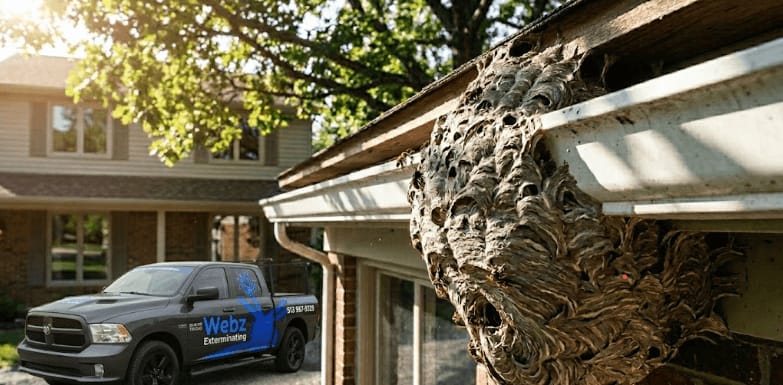
Bald-faced hornets build the large enclosed nest that looks like a grey paper football, hanging from a tree, shrub or roofline. They defend it firmly.
Mud daubers build mud tube nests on walls, porches and garages. Generally far less aggressive — but correct identification still matters, because what looks harmless from a distance is not always what you think.
Why DIY goes wrong
Store-bought spray may not reach the nest. It kills the insects you can see. If the nest is in a wall, underground or tucked into a void, the product never gets to the source, so the activity returns — or the colony scatters deeper into the structure.
Timing matters. Most of these insects are more active during the day. Spraying at peak activity increases the chance of being stung and makes the nest harder to treat, because the colony is moving in and out.
Ground nests are easy to underestimate. One small hole can lead to a much larger nest below. Flooding, burning, sealing or digging at it puts you directly in the colony’s path.
Wall nests can become indoor problems. Treating or sealing the outside opening without knowing what is behind it creates pressure inside the structure, and the insects go looking for another way out. Sometimes that way out is your hallway.
Ladders add risk. Even a small nest is dangerous if you need a ladder. If the colony reacts while you are up there, you have nowhere to go.
What a professional removal actually involves
Inspection and nest location. Finding where they are active, where they are entering, and where the nest actually is — which is not always obvious.
Identification. Yellow jackets, paper wasps, bald-faced hornets and mud daubers should not be handled the same way.
Risk assessment. Nest location, height, activity level, nearby foot traffic, children and pets. That decides how urgent it is and how it gets treated.
Targeted treatment. Chosen for the insect and the location, aimed at the nest rather than at the few insects flying around it.
Nest removal where appropriate. Once activity has stopped, taking the nest down keeps the area clean and removes the pheromone traces that make the same spot attractive next year.
Prevention advice. The gaps, overgrown shrubs, open bins, food sources and sheltered spots under eaves and decks that invite the next one.
When you may not need removal at all
Not every flying insect needs treating, and most pest control blogs skip this part.
A few wasps crossing the yard are foraging. A mud dauber nest somewhere nobody goes may not need urgent action. Honeybees usually need relocating rather than exterminating — if you have a hive, we can generally point you toward a local beekeeper.
The question is risk. Is there an active nest? Is it close to people or pets? Is it near an entry point? Is it in the ground or inside a wall? Is activity increasing? Could someone disturb it by accident?
If the answer to any of those is yes, get help.
What to do in the meantime
Keep people and pets away. Nobody walks, plays, mows, trims or sits near it until it has been checked.
Do not hit, spray, burn, flood or knock it down. All of those trigger defensive behaviour and make the nest harder to treat afterwards. Resist the urge to just take care of it.
Watch from a safe distance. If you can do it safely, note where they are going in and out. Do not stand close, do not block the opening, and do not shine a light into the nest at night.
Keep the yard work away from it. No mowing, trimming, pruning or moving equipment nearby — vibration and movement set off ground-nesting yellow jackets in particular.
Keep food and drink covered outdoors, and keep bins sealed and away from doors. In late summer that matters more than it does in June.
Common questions
Should I remove a wasp nest myself?
Not if it is large, hard to reach, in the ground, inside a wall, or near people and pets. Those are the situations where the risk stops being about a sting or two.
What is the difference between wasps, hornets and yellow jackets?
Size, nest type, behaviour and how defensive they are. Yellow jackets nest in the ground or in hidden spaces; paper wasps build open nests; bald-faced hornets build large enclosed ones. The identification decides the treatment.
Are yellow jacket nests dangerous?
They can be, particularly near walkways, play areas and anywhere yard work happens. A ground nest is easy to disturb by accident while mowing or trimming, and the response is fast.
When are they most active around Cincinnati?
Through the warmer months, with activity building across spring and summer and peaking in August as the colony reaches full size.
How do I stop them nesting here next year?
Check the eaves, soffits, deck underside and shed in spring, when a new nest is small and started by one queen. Seal gaps in the soffit and siding, keep bins closed, trim shrubs back from patios and play areas, and keep food and sweet drinks covered outdoors.